What makes kemari a living link to Japan’s past?

kemari: Japan’s ancient courtly ball game
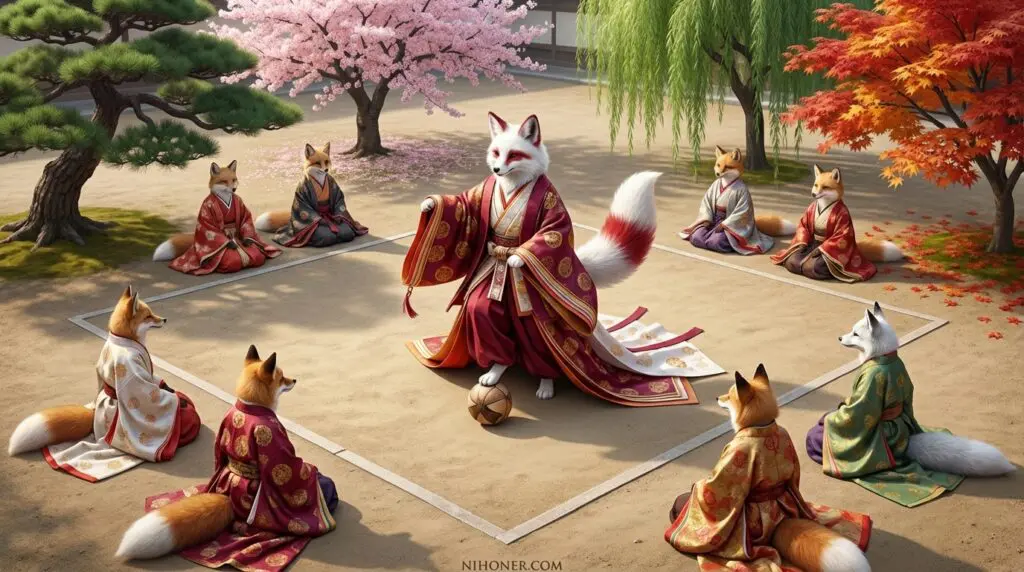
Kemari traces back more than a thousand years to imperial courts and ritual gardens. Because it began among Heian period court nobles the game carries deep cultural weight. Players wear Heian period clothing and move with measured grace. Typically eight participants keep a deerskin ball aloft using only their feet on a square court. The court’s four corners are marked by pine cherry willow and maple trees to symbolize seasons and balance.
Moreover kemari blends athletic skill with ritual formality rather than fostering rivalry. As a result it survives at shrines festivals and preservation societies. Today ceremonies such as Kemari Hajime at Shimogamo Shrine revive tradition and teach technique to new generations. Therefore kemari offers a living link between Japan’s refined past and its modern cultural life.
Because Emperor Meiji later supported preservation efforts the practice regained public attention. Therefore modern observers can study courtly etiquette through movement and language. In sum kemari invites respectful attention to history craft and communal memory.
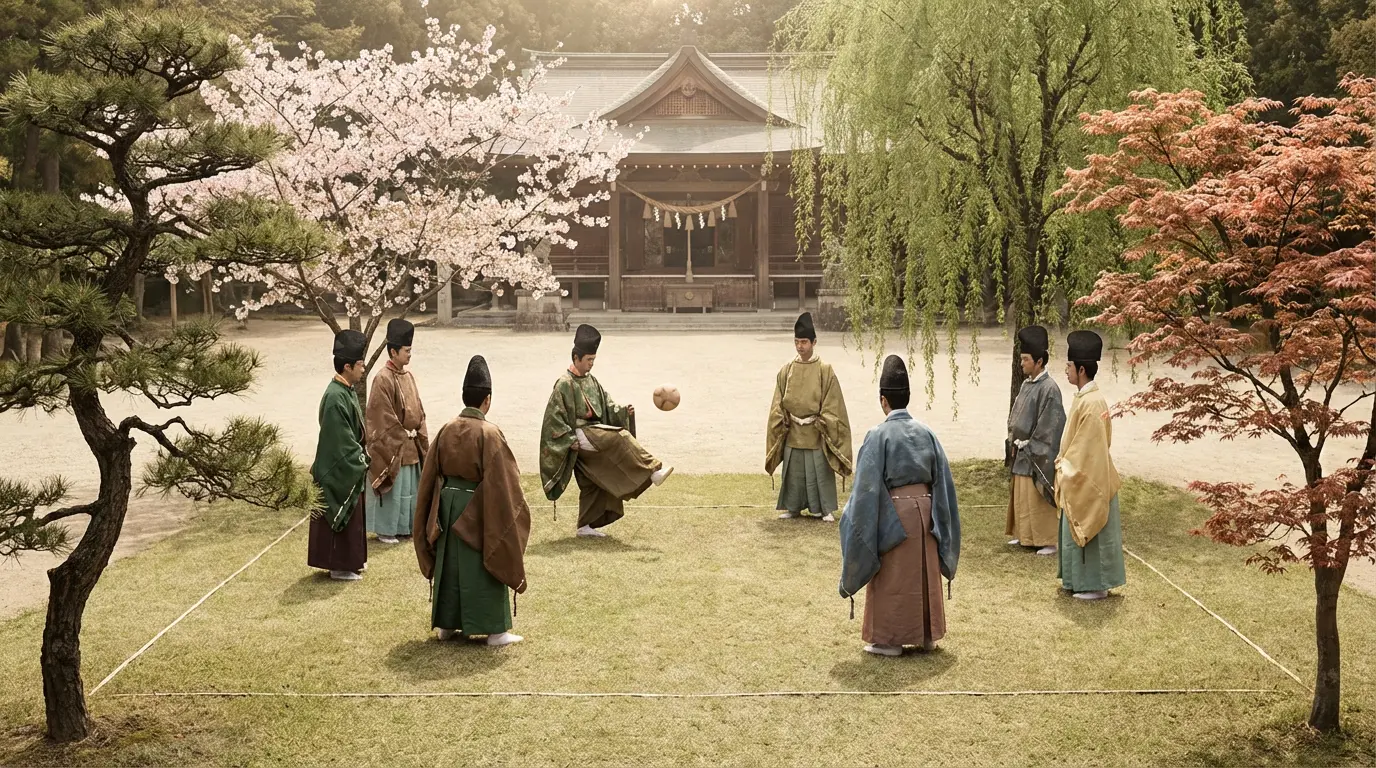
Image shows eight players in Heian-period clothing playing kemari on a grassy square court with the four trees marking corners and a shrine in the background.
Kemari traces its roots more than a thousand years ago as a courtly pastime and ritualized sport. Scholars suggest players adapted ball games introduced from the Asian continent during early medieval Japan, and over time kemari took a distinct form within the imperial court. Because the game emphasized poise and group choreography, nobles treated it less like competition and more like shared ceremony. This origin explains kemari’s lasting association with elite culture and refined Heian period aesthetics.
By the Heian period, kemari became especially popular among court nobles. Players used a deerskin ball and kept it aloft using only their feet. Typically eight participants stood on a square court marked at the corners by pine, cherry, willow, and maple trees. As a result, the game blended athletic skill with ritual formality. Court clothing and slow rhythmic movement reflected Heian ideals of elegance and social harmony.
Kemari later spread beyond the palace to temples and local communities. However, its practice waned by the modern era. In 1907, Emperor Meiji donated funds to establish a kemari preservation society, which revived interest and organized formal demonstrations. Consequently, annual ceremonies resumed at shrines such as Shimogamo in Kyoto. For further reading see Nippon.com, The Kyoto Shimbun, and Green Shinto.
kemari: historical origins and evolution
Kemari traces its roots to more than a thousand years ago. Early court records show ball games arriving from the Asian continent. Over time, nobles adapted those games into a distinct Japanese form at the imperial court. Because kemari emphasized harmony and poise, it became less competitive and more ceremonial.
By the Heian period, kemari was a favored pastime among court nobles. Players used a deerskin ball and kept it aloft using only their feet. Typically eight participants stood on a square court. The court’s corners were marked by pine, cherry, willow, and maple trees to symbolize seasons and balance. Moreover, players wore Heian period clothing, and movements followed refined, timed patterns rather than direct contest.
The equipment and setup highlight kemari’s ritual character. Balls were crafted from stitched deerskin and maintained a soft, responsive feel. Players arranged themselves in a loose circle and passed the ball with controlled kicks. As a result, the game tested balance, timing, and group coordination more than speed.
Kemari spread to temples and regional communities, but practice declined in the modern era. In 1907, Emperor Meiji donated funds to establish a kemari preservation society, which revived demonstrations and teaching. Therefore, annual ceremonies returned to shrines such as Shimogamo in Kyoto. For further context see Nippon.com and The Kyoto Shimbun.
Consequently, kemari today stands as a living bridge between Heian aesthetics and modern cultural practice. It preserves courtly etiquette, seasonal symbolism, and communal memory.
| Game | Origin period | Typical number of players | Playing equipment | Court or play area | Cultural significance |
|---|---|---|---|---|---|
| kemari | Heian period and earlier | Eight players | Deerskin ball kept aloft with feet | Square court marked by pine, cherry, willow, maple trees | Ritualized court pastime; preserves Heian aesthetics and etiquette |
| Dakyu | Nara to Kamakura periods | Four to six per team | Wooden mallets and leather ball | Open field or arena | Cavalry training and sport; influenced samurai culture |
| Tamaire | Edo period | Large teams, variable sizes | Small balls or beanbags | Open ground or festival lot | Community festival game at school and public events |
| Hanetsuki | Muromachi to Edo periods | Usually two players | Shuttlecock | Courtyard or indoor space | New Year pastime to ward off evil and celebrate girls |
kemari today: practice and cultural significance
kemari at shrines and festivals
Today kemari survives as a ceremonial performance at shrines and cultural gatherings. Notably Kemari Hajime takes place at Shimogamo Shrine in Kyoto each January 4. Visitors may watch players dressed in Heian period clothing. Because organizers stage the event publicly, audiences can see traditional form and timing. For details see the shrine site Shimogamo Shrine.
Players follow a ritualized pattern rather than a competitive game. Typically eight participants stand on a square court. The corners are marked by pine, cherry, willow, and maple trees. They keep a stitched deerskin ball aloft using only the feet. As a result the display emphasizes balance, timing, and collective skill.
Preservation societies sustain practice and training. In 1907 Emperor Meiji donated funds to form a kemari preservation society, which revived demonstrations and teaching. Therefore organized groups now run workshops and coordinate shrine performances. For historical background see Nippon.com and local reporting such as The Kyoto Shimbun.
Ultimately kemari matters because it links past and present. Moreover it teaches cooperation rather than rivalry. Community ties strengthen when players and spectators meet. As a result kemari remains a quiet, living tradition that honors Heian aesthetics and social harmony.
Kemari stands as a living symbol of Japan’s cultural continuity and historical richness. For more than a thousand years it has linked courtly ritual with communal life. Today its graceful choreography, Heian clothing, and shrine ceremonies keep that legacy visible. Because the game emphasizes cooperation over competition, it preserves social values as much as physical skill.
For learners and curious readers, Nihoner.com provides an all-in-one platform to explore this heritage. The site features a large Japanese dictionary, a pronunciation trainer, and structured courses. Moreover it offers cultural guides that link language learning to places and traditional practices. Therefore users can study historical vocabulary and cultural context side by side while making measurable progress.
In short, kemari teaches more than sport; it teaches continuity, etiquette, and communal memory. By combining historical study with practical language tools, Nihoner.com helps learners make real progress. Respectful engagement with traditions like kemari ensures that Japan’s past remains alive and instructive.
CONCLUSION
Kemari remains a living bridge between courtly ritual and communal life in Japan. Rooted in Heian aesthetics, the game teaches balance, decorum, and collective care. Because it values cooperation over competition, kemari sustains social ties and seasonal symbolism. Communities keep the practice alive through shrine ceremonies and preservation societies. In 1907 Emperor Meiji’s support helped formalize those efforts, and therefore public demonstrations returned.
For learners, Nihoner.com helps connect language learning with cultural understanding. The platform offers a large Japanese dictionary and pronunciation trainers. It also provides structured courses, interactive quizzes, and guided lessons on cultural topics. Moreover Nihoner.com supplies cultural guides that explain festivals, clothing, and ritual forms. As a result learners make measurable progress in vocabulary and comprehension.
In sum kemari teaches history, etiquette, and communal memory. Respectful engagement with this tradition deepens cultural literacy. By pairing practical language tools with cultural content, Nihoner.com helps learners study and honor Japan’s living past.
Frequently Asked Questions (FAQs)
What is kemari?
Kemari is an ancient Japanese ball game dating back over a thousand years. Players use a stitched deerskin ball and keep it aloft using only their feet. Typically eight participants play on a square court marked by pine, cherry, willow, and maple trees. The game emphasizes grace, cooperation, and ceremonial form.
How did kemari originate and evolve?
Kemari developed among Heian period court nobles and adapted earlier continental ball games. Because nobles prized poise the game became ritualized rather than competitive. Over time kemari spread to temples and local communities. In 1907 Emperor Meiji helped fund preservation efforts that revived public demonstrations and teaching.
Where can I watch kemari today?
You can see kemari at shrine festivals and cultural events. For example Kemari Hajime at Shimogamo Shrine in Kyoto takes place each January 4. Preservation societies and shrines also stage demonstrations and offer occasional workshops for visitors.
What do players wear and what is the ceremony like?
Players wear Heian period clothing to honor tradition. Movements are measured and rhythmic, and the display focuses on timing, balance, and group harmony. Therefore performances feel ceremonial rather than sporty.
Is kemari competitive and can anyone learn it?
Kemari is not competitive. Instead it trains balance and cooperative skill. However interested learners may join workshops run by preservation groups and shrines to learn technique and cultural context.
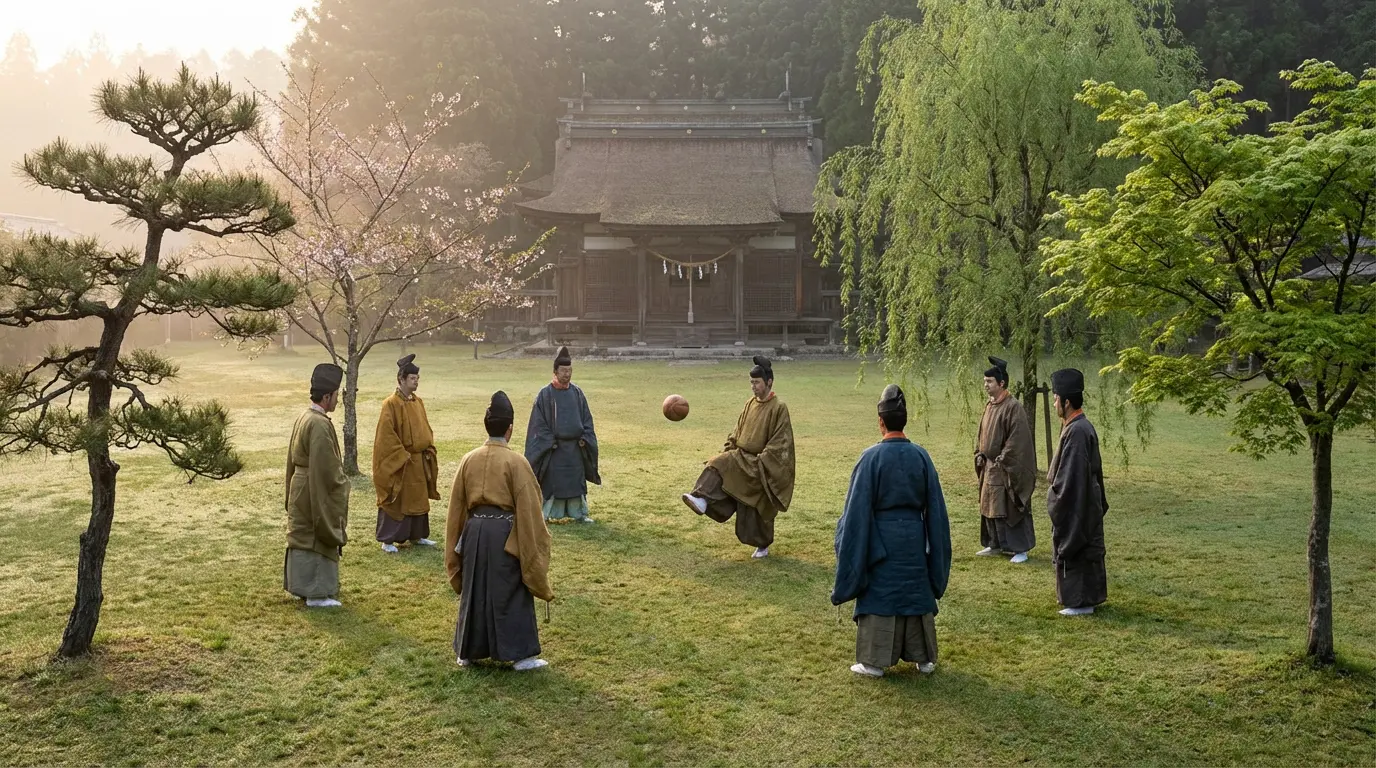
Image shows eight players in Heian period clothing playing kemari on a grassy square court. The court corners are marked by pine, cherry, willow, and maple trees. A deerskin ball is captured mid-air and a traditional shrine sits at a respectful distance in the background, adding historical context.