What does に particle in existential Japanese sentences (〜に〜があります) convey?


Discovering the に Particle in Existential Japanese Sentences: 〜に〜があります
Understanding the intricacies of the に particle in existential Japanese sentences, such as 〜に〜があります, is vital for every Japanese learner aiming to speak naturally and correctly. With its role in expressing location, the に particle helps clarify where something exists, making it a cornerstone of meaningful communication.
For instance, saying “部屋にキッチンがあります” (heya ni kicchin ga arimasu) could literally translate to “In the room, a kitchen exists,” showing the situation’s geographical context. Grasping the usage of に in such sentences not only enhances grammatical precision but also enriches your overall understanding of Japanese syntax.
Dive in as we explore how mastering this particle can transform your language proficiency.
Understanding the に particle in existential Japanese sentences (〜に〜があります)
The に particle marks the location where something exists. In existential sentences like 〜に〜があります, に points to the place and が marks what exists. Because Japanese uses argument structure, each phrase links directly to the verb あります. This makes meaning clear and predictable.
Take this example and its natural three block structure.
- 部屋に (heya ni) meaning “in the room” marks the location of existence
- キッチンが (kicchin ga) meaning “kitchen” marks the subject that exists
- あります (arimasu) meaning “exists” is the existence verb
In this sentence the most basic and natural order is 〜に〜があります. However, you can reorder the blocks without changing the basic meaning because both 部屋に and キッチンが are arguments of あります. For example, キッチンが部屋にあります keeps the same core idea. In contrast, に used for direction differs in nuance. Here に shows static location of existence, not movement.
For clearer practice and more particle explanations, try our grammar references at Nihoner grammar guide. This helps you see clear steps and better sentence building.
Progress tracking promise: Track your learning and receive feedback on sentence order and particle use when you register for free at Nihoner free membership.
Checkpoint: Mastering に in 〜に〜があります lets you state where things exist with clarity and confidence.
に particle in existential Japanese sentences (〜に〜があります): location vs direction
| Use | Example | Grammatical role | Natural sentence order | Notes |
|---|---|---|---|---|
| Location of existence | 部屋にキッチンがあります (heya ni kicchin ga arimasu) — “There is a kitchen in the room.” | • に(particle) marks the location of existence • が marks the subject that exists | • 〜に〜があります is the most natural order • Blocks can be reordered without changing meaning | • Static location • Core 日本語文法 for expressing existence; see Nihoner grammar guide |
| Direction or movement | 部屋に行きます (heya ni ikimasu) — “I go to the room.” | • に marks destination or target • Verb indicates motion | • Destination before verb is normal • Order reflects movement toward place | • Implies motion not state • Use verbs like 行く for direction |
Micro win invitation: Try this quick swap to build clarity and certainty. Say 部屋にキッチンがあります and then キッチンが部屋にあります aloud. Track your progress and get feedback when you register for free at nihoner.com.
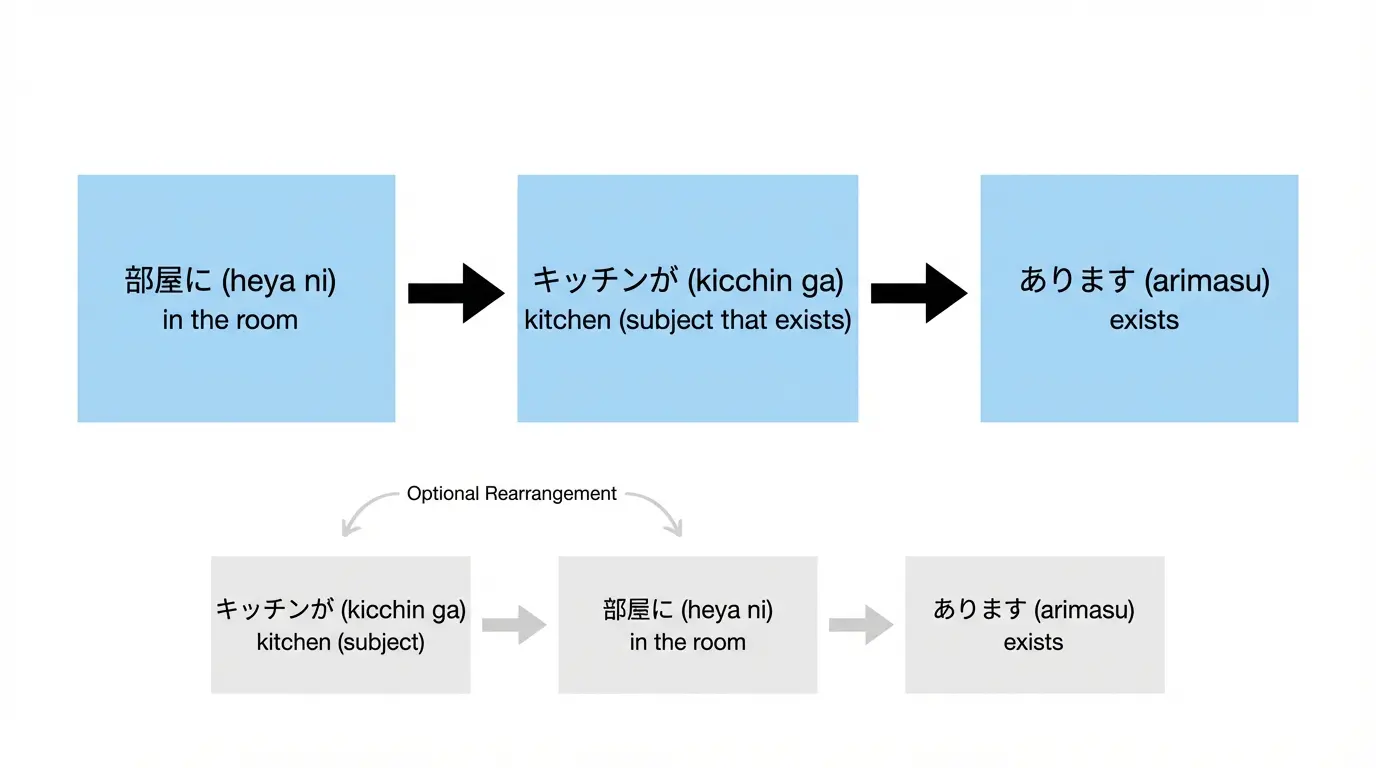
Argument structure and word order flexibility for に particle in existential Japanese sentences (〜に〜があります)
The verb あります takes two arguments that attach independently. First, に marks the location of existence. Second, が marks the subject that exists. Because each phrase links directly to あります, the sentence keeps its meaning even when you change the order. This is the heart of the 三つのブロック構造 (mittsu no burokku kōzō) meaning “three block structure” in Japanese grammar.
For example, the natural order is clear.
部屋にキッチンがあります(heya ni kicchin ga arimasu) meaning “There is a kitchen in the room.”- Breakdown:
部屋に(heya ni) meaning “in the room” •キッチンが(kicchin ga) meaning “kitchen, subject” •あります(arimasu) meaning “exists”
However, you can reorder the arguments without changing the core meaning because of 語順の変更(順序を入れ替える) (gojun no henkō (junjo o irekaeru)) meaning “word order change (swap order)”. For example:
- Natural:
部屋にキッチンがあります(heya ni kicchin ga arimasu) — “There is a kitchen in the room.” - Reordered:
キッチンが部屋にあります(kicchin ga heya ni arimasu) — “The kitchen is in the room.”
Notice that both phrases still act as arguments of あります. Therefore, syntax is flexible, yet meaning stays stable. For learners, this reduces anxiety because sentence building becomes predictable. In addition, practicing these swaps helps you feel like a confident Japanese speaker, reinforcing your identity as a capable learner.
Premium pronunciation support: Use Nihoner’s pronunciation training with native audio to master natural intonation for sentences like these. It reduces speaking anxiety and helps you sound like the learner you want to be. Learn more at Nihoner’s Pricing.
Identity based encouragement: Ready to show your progress and save example sentences? Register at Nihoner’s Free Membership for guided feedback and tracking.
Checkpoint: Remember that に and が are separate arguments of あります, so you can reorder blocks while keeping the same basic meaning.
CONCLUSION
This article explained the に particle in existential Japanese sentences 〜に〜があります (ni … ga arimasu) meaning “there is … in …” and used to state location of existence. Understanding this pattern helps you form natural and correct Japanese sentences. Therefore, mastering に improves your clarity when describing where things are.
- に(particle) marks the location of existence.
- が(subject marker) shows what exists.
- The three block structure 部屋に/キッチンが/あります (heya ni / kicchin ga / arimasu) clarifies roles.
- 語順の変更(順序を入れ替える) lets you reorder blocks without changing the core meaning. In contrast, に for direction shows movement rather than state.
Nihoner.com supports this learning path with a large Japanese dictionary, a pronunciation trainer, structured courses, and practical cultural content. In addition, the site focuses on real understanding and efficient study so you learn with clarity and certainty. As a result, you gain confidence in speaking and using natural Japanese.
Progress tracking promise: Save example sentences, review pronunciation practice, and watch your progress over time when you register for free at Nihoner Free Membership Registration. This helps you see improvement and stay motivated.
Checkpoint: Master the 〜に〜があります pattern and you will comfortably state where things exist in Japanese.
Frequently Asked Questions (FAQs)
What does に mark in existential sentences?
に marks the location where something exists. For example, 部屋にキッチンがあります (heya ni kicchin ga arimasu) meaning “There is a kitchen in the room” used to point to place. This gives clarity and certainty.
Does 〜に〜があります require a fixed word order?
No. The pattern follows a three block structure that reads naturally as 〜に〜があります. However, you can reorder blocks because both phrases attach to あります. This flexibility reduces anxiety when you speak.
Can I swap the subject and location?
Yes. Compare 部屋にキッチンがあります (heya ni kicchin ga arimasu) meaning “There is a kitchen in the room” with キッチンが部屋にあります (kicchin ga heya ni arimasu) meaning “The kitchen is in the room.” Both keep the same core meaning.
How is に for location different from に for direction?
For location, に shows static place of existence. For direction, に marks destination and implies movement. Example for direction: 部屋に行きます (heya ni ikimasu) meaning “I go to the room.”
Why use が instead of は with あります?
が marks what exists without topicalizing. In contrast, は adds contrast or topic focus. For example, 部屋にはキッチンがあります (heya ni wa kicchin ga arimasu) meaning “As for the room, there is a kitchen” used to emphasize the room.