What is 来なんだ and why does it sound ancient?


Unraveling the Mystery of 来なんだ: An Archaic Japanese Grammar Gem
When diving into the depths of Japanese grammar, the term 来なんだ (kailananda) might seem like an enigma. This intriguing form is an archaic negative past verb ending that was commonly used in dialogue during the Muromachi era through the late Edo era. Essentially, it translates to 来なかった (kinakatta), meaning “did not come.” Although it may sound old-fashioned today, especially as the ~なかった form gradually took over, it still makes appearances in dramas or depictions of the past. Understanding this piece of history can enrich your appreciation of the language’s evolution.
Curious about learning more? Consider joining Nihoner for free! Register today to explore Japanese grammar deeper by expanding your knowledge on these fascinating old forms. Register now and deepen your understanding.
Historical background of 来なんだ (konanda) meaning “did not come”
The form 来なんだ (konanda) is an archaic negative past verb ending used in earlier stages of Japanese. Digital Daijisen discusses this development and places the form in regular use from the Muromachi era to the late Edo era. In short, it functioned like the modern 来なかった (konakatta) meaning “did not come.” For learners, this explains why you hear it in historical drama dialogue and old literature.
- Muromachi era — emergence and early use, often in spoken and poetic registers.
- Edo era — continued use across regions and registers, including everyday speech and fiction.
- Late Edo onward — gradual replacement by the modern negative past form ~なかった (nakkattta), as recorded by Digital Daijisen.
After the Edo era, the ~なかった form became dominant. Therefore the special ending faded from most mainstream speech. However, traces survive in regional speech, especially Kansai dialects, and in period drama scripts.
Related keywords to explore: Muromachi era, Edo era, archaic form, Digital Daijisen, Japanese grammar.
Identity based encouragement: If you enjoy studying historical Japanese, this detail helps you read older texts with more confidence. Many learners find these discoveries rewarding and clarifying.
Ready to study deeper? Join Nihoner to keep progressing and collect micro wins as you learn. Register for free at Nihoner registration.
Checkpoint: 来なんだ (konanda) equals the negative past meaning “did not come.”
Modern usage of 来なんだ (konanda) in Kansai dialects
In modern speech, 来なんだ (konanda) meaning “did not come” is heard mainly in Kansai dialects. For clarity, 来なんだ (konanda) equals the older negative past and maps to modern 来なかった (konakatta). However, usage is shrinking in everyday talk.
- Regional shift — Kansai dialects keep older endings alive, often in casual conversation or fiction.
- Replacement trend — Wikipedia notes that ~んかった (n’katta) meaning “did not” in Kansai negative past is becoming more common than ~なんだ (nanda) in many areas.
- Media examples — You often hear this styling in period pieces and in characters who sound old fashioned. For example, 波平 (Namihei) is a character from the anime Sazae-san used to represent an older voice. Dumbledore is another example where writers use archaic phrasing for a wise, old tone.
Try a short practice: listen for one example line in a Kansai speaker, then repeat it slowly to build confidence. This creates micro wins and reduces anxiety by focusing on one clear step.
Premium help: Nihoner offers pronunciation training with native audio to master dialect nuance. It lets you hear subtle differences and copy natural rhythm. Learn more.
Progress promise: track your progress and unlock clearer hearing by registering for free at Nihoner Free Membership.
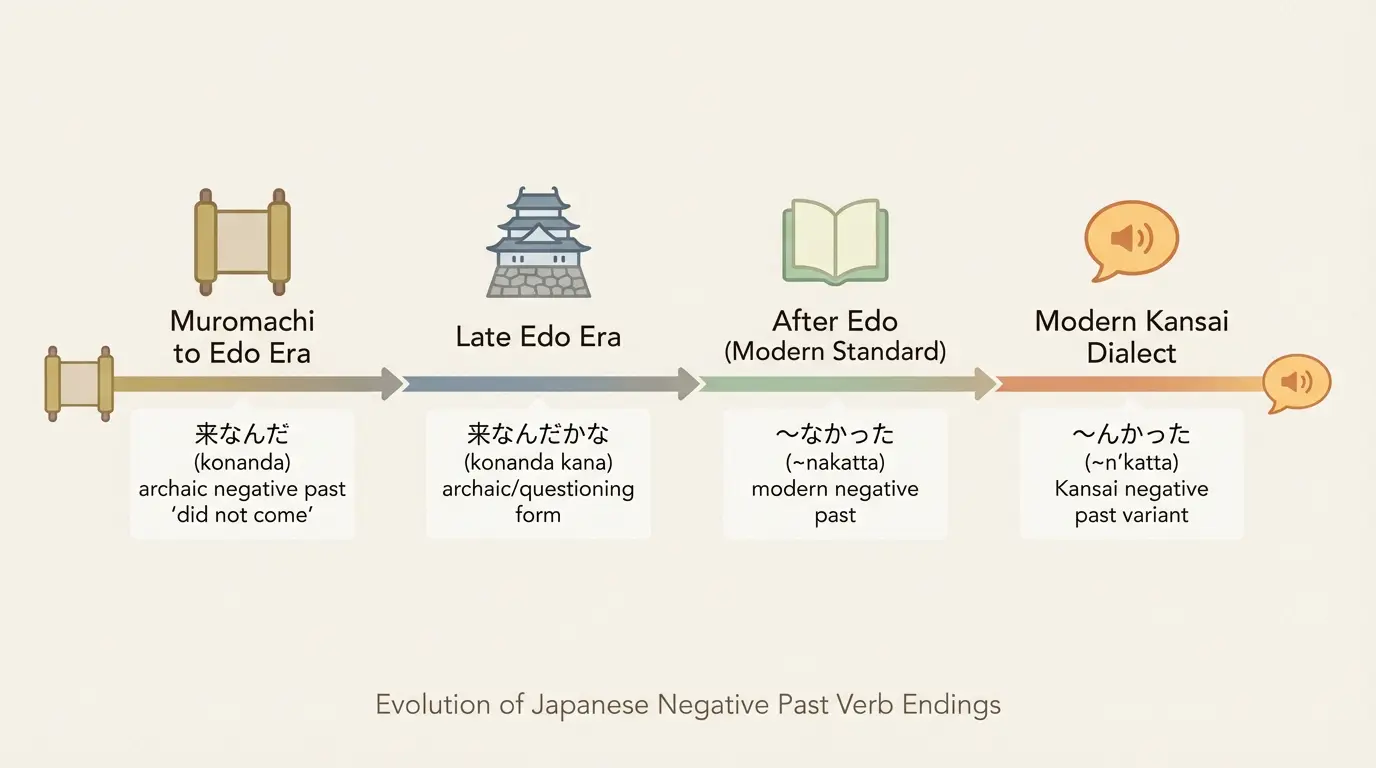
| Era or Region | Form | Meaning | Usage notes | Example sentence with romaji and translation |
|---|---|---|---|---|
| Muromachi to late Edo | 来なんだ (konanda) | meaning “did not come” | Negative past | 「彼は来なんだ。」 (kare wa konanda) meaning “He did not come.” |
| Muromachi to late Edo | 来なんだかな (konanda kana) | meaning “did he not come, I wonder” | Negative past with wondering tone | 「彼は来なんだかな。」 (kare wa konanda kana) meaning “I wonder if he did not come.” |
| After Edo onward, standard Japanese | ~なかった (〜nakatta) | meaning “did not” | Negative past | 「彼は来なかった。」 (kare wa konakatta) meaning “He did not come.” |
| Modern Kansai dialects | ~んかった (〜nkatta) | meaning “did not” | Negative past | 「彼は来んかった。」 (kare wa konkatta) meaning “He did not come.” |
Related keywords: 来なんだ, 来なんだかな, 来なかった, ~んだ, 時代劇 (jidaigeki) meaning “period drama”, Kansai dialects, archaic form.
This clear table offers clarity and a simple progress checkpoint to track your learning. If you want regular practice and guided examples, register for free at nihoner.com to keep improving.
CONCLUSION
This article traced the history and living traces of 来なんだ (konanda) meaning “did not come”. Digital Daijisen records the form from the Muromachi era through the late Edo era. Over time it gave way to the modern negative past form 〜なかった (nakatta) meaning “did not”. However, old endings persist regionally. In modern Kansai dialects you still hear 〜んかった (n’katta) meaning “did not” used instead of 〜なんだ in many contexts.
For learners, these patterns matter for reading period texts and for recognizing style in media. You will hear 来なんだ (konanda) in 時代劇 (jidaigeki) meaning “period drama” and from characters who sound old fashioned. For example, the character 波平 (Namihei) from Sazae-san often uses older speech, and authors sometimes give Dumbledore archaic phrasing to signal age.
Nihoner.com is an all in one platform that helps learners use Japanese in real life. It combines a dictionary, pronunciation support, structured courses, smart SRS flashcards, quizzes, game based practice, and cultural content. This gives clear study paths and supports your learner identity as someone who reads beyond modern speech.
If you want steady progress, register for free and track your learning at Nihoner Free Membership.
Frequently Asked Questions (FAQs)
What does 来なんだ (konanda) mean?
It is an archaic negative past verb ending meaning “did not come.” This concise answer gives clarity so you can be certain about the basic meaning.
How does 来なんだ compare to 来なかった (konakatta)?
来なんだ (konanda) and 来なかった (konakatta) mean the same negative past. However, 来なんだ is older and appears in historical texts and speech.
When was 来なんだ used historically?
Digital Daijisen records this form from the Muromachi era to the late Edo era. After the Edo era, the standard negative past 〜なかった (nakatta) became dominant.
Is 来なんだ used in modern Japanese?
Yes, mainly in Kansai dialects and in media that mimic older speech. Also you may hear it in 時代劇 (jidaigeki) meaning “period drama” or from characters meant to sound old fashioned.
How can I practice recognizing these forms?
Listen to period drama lines and Kansai speakers, then compare with modern sentences. Use these questions as checkpoints to track your progress.
Checkpoint One sentence summary Learn to map 来なんだ (konanda) to the modern 来なかった (konakatta) to understand negative past forms across time.