How to improve Japanese listening comprehension in continuous speech?


Japanese listening comprehension in continuous speech: Why fluent Japanese sounds like a blur
Japanese listening comprehension in continuous speech feels impossible sometimes. You can parse single sentences when they are spoken clearly, yet when people speak naturally everything blurs together. However, it is frustrating because the words and grammar are familiar, but comprehension drops in conversations, podcasts, and dramas. Why does this happen and what actually fixes it? There are clear reasons and trainable skills behind the blur.
This article focuses on targeted training that closes the gap. Instead of vague study tips, we look at the specific skills that fail in continuous speech and practical drills to rebuild them. My aim is to give clarity and certainty about what to practice and why. At the same time, the tone stays supportive to promote reduced anxiety while you practice. Ready to stop guessing and start improving?
Checkpoint: One focused practice session can reveal which listening skill is missing.
Japanese listening comprehension in continuous speech: an overview
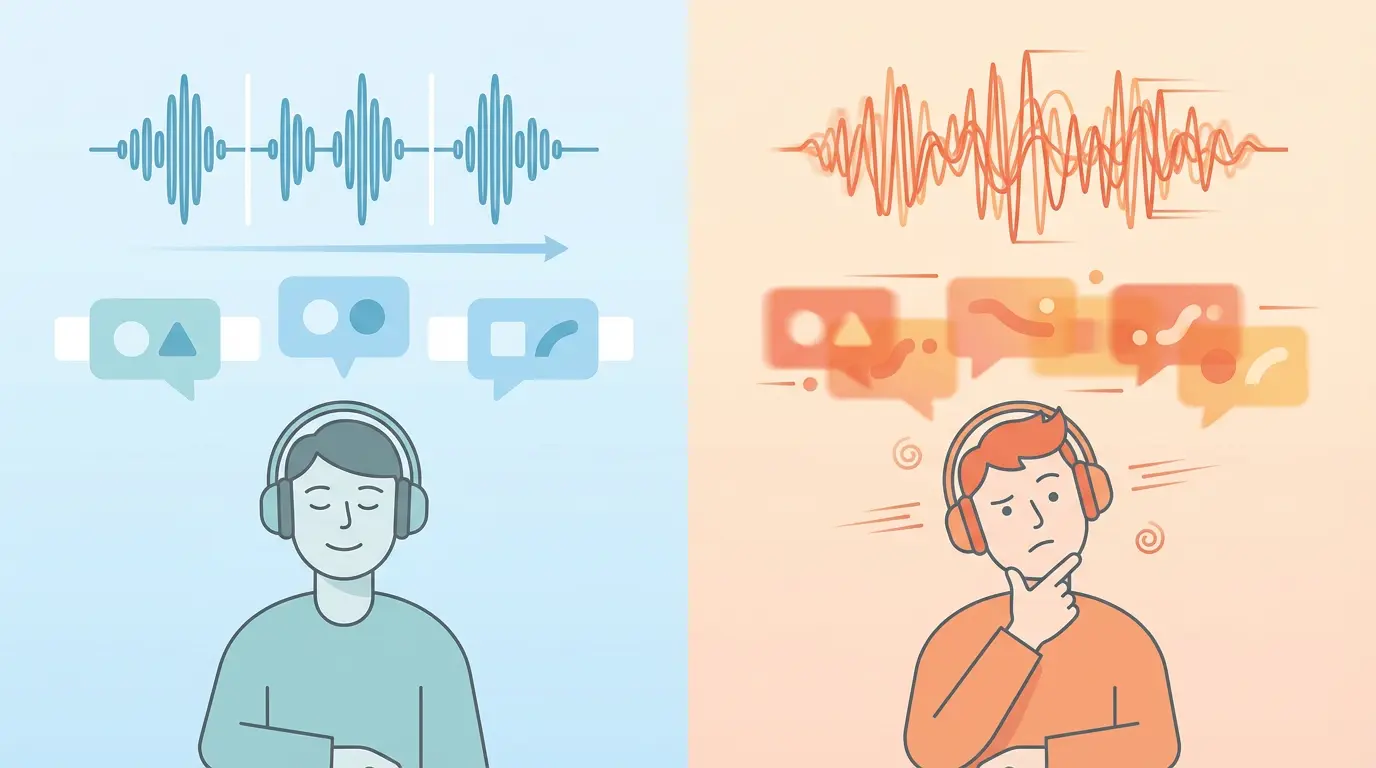
Many learners can understand clear single sentences but struggle when those same sentences appear inside conversations, podcasts, or dramas. For example, natural speech often runs words together and reduces or omits sounds, so parsing becomes harder even when vocabulary and grammar are familiar. In addition, pace, overlapping speakers, and casual contractions raise processing load and hide phrase boundaries. As a result, comprehension can drop sharply in continuous speech compared to single sentence listening.
Causes range from connected speech phenomena to insufficient real time segmentation skills. However, it is rarely only a vocabulary or grammar gap. Often the missing ability is prediction and fast chunking so you can keep up with spoken Japanese. In other words, standard single sentence drills do not train the timing and grouping skills needed for conversation or podcasts.
This article will uncover specific explanations and targeted training solutions rather than vague tips. It aims to give clarity and certainty about what to practice, and it seeks to reduce anxiety while you work. Next we will diagnose which listening skill is weakest and propose practical drills to rebuild it.
Why Japanese listening comprehension in continuous speech is so hard
Understanding single sentences and following natural conversations are two different skills. When speech runs together, your brain must do more work to segment sounds, predict upcoming words, and keep meaning in working memory. Here are the main causes learners face.
- Cognitive load and working memory
- Continuous speech increases processing demands. You must hold fragments in working memory while you wait for clarifying cues. As a result, comprehension drops when several elements pile up.
- Prediction becomes essential. Instead of translating word by word, fluent listeners predict likely particles and verb forms to stay ahead.
- Natural speech contractions and linking sounds
- Native speakers reduce vowels, elide particles, and link words. For example, casual forms and contracted phrases remove clear boundaries between words.
- These connected speech phenomena hide grammar markers and disguise familiar vocabulary.
- Fast pace and overlapping speakers
- Conversations and podcasts often move faster than practiced single sentence drills. Faster speech leaves less time to reprocess unclear sounds.
- Multiple speakers or interruptions add competing audio information and raise the chance of missing the cue that clarifies meaning.
- Vocabulary and grammar challenges in context
- Even known words can be hard to spot when their pronunciation is altered or when they appear in compressed phrases.
- Casual grammar and colloquial expressions differ from textbook forms. Recognizing them requires exposure and focused practice rather than simple review.
For authoritative perspectives and practical examples, community discussions on Japanese Stack Exchange and Japanese Meta Stack Exchange give helpful context and real learner reports. For instance, users often report similar segmentation and reduction issues when discussing natural speech comprehension on those sites.1
Registration invitation — progress tracking promise
Join a free account to track small listening wins and keep practice visible as you improve. Sign up here: Nihoner Free Membership
Premium upsell — pronunciation trainer with native audio
If you struggle to hear reduced sounds and contractions, consider the AI pronunciation trainer with native audio. It helps you practice realistic pronunciations and reduces uncertainty about what you heard. Learn more: Nihoner AI Pronunciation Trainer
Checkpoint: Identify whether missing boundaries or processing speed causes most of your loss in comprehension.1
Practical training to improve Japanese listening comprehension in continuous speech
Training must be specific and layered. Instead of general study tips, practice should mimic real conversations and train the brain to segment and predict in real time. Below are focused methods you can use right away.
- Listening with podcasts, dramas, and conversations
- Start with short clips and repeat them often. For example, loop 30 second segments and listen actively.
- Use slowed playback only to build accuracy. Then return to normal speed to build real time processing.
- Focused drills for natural speech patterns
- Practice shadowing small phrases to feel rhythm and linking sounds. This trains your ear to expect reductions.
- Use segmentation drills. Pause after each perceived chunk and write what you heard. Then compare to a transcript.
- Vocabulary and grammar drills in context
- Make stacked SRS flashcards for common reduced forms and colloquial expressions.
- Add sample audio clips to cards so you see and hear items in natural contexts.
- Tools and community support
- Share tricky clips with learners on Japanese Stack Exchange for explanation and transcription help. For example, post a short excerpt and ask which reductions occur.
Identity based encouragement — micro wins
You already think of yourself as a serious listener. Celebrate small wins like spotting a reduced particle. Those moments prove progress and build identity as a fluent listener.
Join for tracking and small victories
Create a free account to save clips and track listening wins: Free Membership
Premium suggestion
If you want guided pronunciation practice with native audio, the Nihoner pronunciation trainer helps you hear reductions and practice realistic intonation. See pricing and upgrades: Pricing and Upgrades
Try this now: Pick a 30 second podcast clip, loop it five times, and shadow one line. Expect clearer phrase boundaries after three repetitions.
| Aspect | Single sentences | Continuous natural speech |
|---|---|---|
| Comprehension difficulty | Low to moderate when clear | High; often drops sharply even with familiar vocabulary |
| Common issues | Misheard rare words; isolated grammar gaps | Reduced sounds, linking, elision, overlapping speakers, fast pace |
| Training focus areas | Vocabulary accuracy; clear pronunciation recognition | Real time segmentation; prediction; rhythm and reduction patterns |
| Recommended tools and resources | Slow, clear audio clips; sentence drills; SRS for vocabulary | Short podcast/drama clips; shadowing; segmentation drills; stacked SRS; community help on Japanese Stack Exchange |
CONCLUSION
Japanese listening comprehension in continuous speech is a different skill than understanding single, clear sentences. Natural speech compresses syllables, links words, and speeds up. That increases cognitive load and removes the clean boundaries learners rely on. As a result, comprehension can drop even when vocabulary and grammar are familiar.
Targeted training fixes this gap. Focus on real-time segmentation, prediction, and rhythm through shadowing, segmentation drills, and short repeated clips from podcasts or dramas. Use stacked SRS to lock in reduced forms and colloquial grammar. Community sites like Japanese Stack Exchange can clarify confusing reductions and give transcription help.
Nihoner.com is designed for learners who want real progress. It combines a large comprehensive dictionary, structured courses, smart SRS flashcards, a pronunciation trainer with native audio, and cultural content to practice real speech. These features help reduce uncertainty and make progress visible as you absorb natural Japanese.
If continuous speech feels overwhelming, remember that clear practice steps lead to measurable gains. Keep drills short, track small wins, and gradually increase clip length. Nihoner supports that stepwise journey so you gain confidence and start understanding natural Japanese in real time.
Frequently Asked Questions (FAQs)
What causes the sudden drop when I listen to continuous natural speech?
When speech runs together your brain must segment and predict faster. In addition, reduced vowels and linked words hide familiar grammar markers. As a result, working memory and real time processing become the bottleneck.
How should I use podcasts or dramas for focused practice?
Start with short clips and listen actively. For example, loop thirty second segments, shadow one line, then compare with a transcript. Then raise speed or length as your accuracy improves.
Which drills fix reductions and linking sounds most effectively?
Do segmentation drills and shadowing daily. Pause after each perceived chunk and write or repeat it. Over time you will train rhythm detection and reduce guesswork.
How can I make SRS flashcards work for natural speech forms?
Use stacked SRS for reduced forms and colloquial phrases. Add short audio clips to cards and test recognition, not just spelling. That trains your ear for altered pronunciations.
How long until I notice real improvement?
Short wins appear in weeks if you practice deliberately. Track tiny gains like spotting a reduced particle. Then increase clip difficulty to keep making visible progress.
Create a free account to log clips and track listening wins: Register here.
If hearing reductions remains hard, try the Nihoner pronunciation trainer with native audio. It gives focused listening and speaking practice and supports confident comprehension: Learn more.