Are hako and hakobu related? Etymology


Are 箱 (hako) and 運ぶ (hakobu) related?
Etymology is the central question of this article. This introduction sets the scope and explains the method. It signals a careful, evidence based inquiry.
The article explores whether the noun 箱 meaning box and the verb 運ぶ meaning to carry share a common origin. Because the two words overlap semantically, a possible link seems plausible. However, similarity in meaning alone does not prove relatedness. Therefore, we examine historical attestations, phonetic change, and lexicographic records.
We review early citations in the Nihon Shoki and the Man’yōshū. Moreover, we consult modern reference works such as the Nihon Kokugo Daijiten and the 1603 Nippo Jisho. We also consider hypotheses about older forms like pako and suffixal behaviour of -ぶ and -びる. As a result, the reader will gain a clear sense of what evidence supports a link and what questions remain.
Related keywords and concepts addressed include Old Japanese, phonetic shifts, pako₁bu, pako₂bu, suffix -ぶ, Nippo Jisho, NKD, and lexical semantics. In short, the purpose is analytical and cautious, and the approach combines philology with historical linguistics.
Historical origins and earliest citations — Are 箱 (hako) and 運ぶ (hakobu) related? Etymology
The earliest evidence separates the two words in time, but it also leaves room for a connection. Nihon Kokugo Daijiten records 箱 cited in the Nihon Shoki dated 720, and it lists Man’yōshū attestations from the later eighth century. Therefore, hako has a clear Old Japanese presence. For NKD access, see Nihon Kokugo Daijiten and consult Kotobank’s summary at Kotobank.
By contrast, NKD’s earliest citation for 運ぶ appears in a Buddhist text from 883. As a result, hakobu is first securely attested in Early Middle Japanese. However, the NKD entry does not prove that the verb did not exist earlier; it may simply have lacked attestation. Kotobank summarizes modern dictionary notes on 運ぶ at Kotobank.
Key documented phonetic forms and historical notes
- pako: Scholarly reconstructions propose an Old Japanese form pako for words related to hako. Moreover, the Old Japanese vowel is often described as the o-type 乙類.
- pako→hakobo/hako: Phonetic change scenarios suggest initial p became h in later stages. Consequently, pako could yield hako through regular sound change.
- Faco and Facobi: The 1603 Nippo Jisho records Faco and Facobi, which reflect Early Modern transcriptions of hako and related verb forms. For discussion of the Nippo Jisho, see Meiji Gakuin and Kyoto University.
Additional chronological points
- Man’yōshū (circa 759) supplies early poetic usage of 箱, as recorded in Old Japanese corpora such as ONCOJ.
- Nippo Jisho (1603) gives Faco and Facobi spellings, which show how European transcribers heard Japanese pronunciations in that era.
Finally, scholars note that no incontrovertible text shows Old Japanese hakobu written as pako₁bu or pako₂bu. Thus, while phonetic and semantic evidence remains suggestive, direct attestation currently remains absent. Consequently, the timeline supports hako’s early attestation and places hakobu’s first secure citation several centuries later.
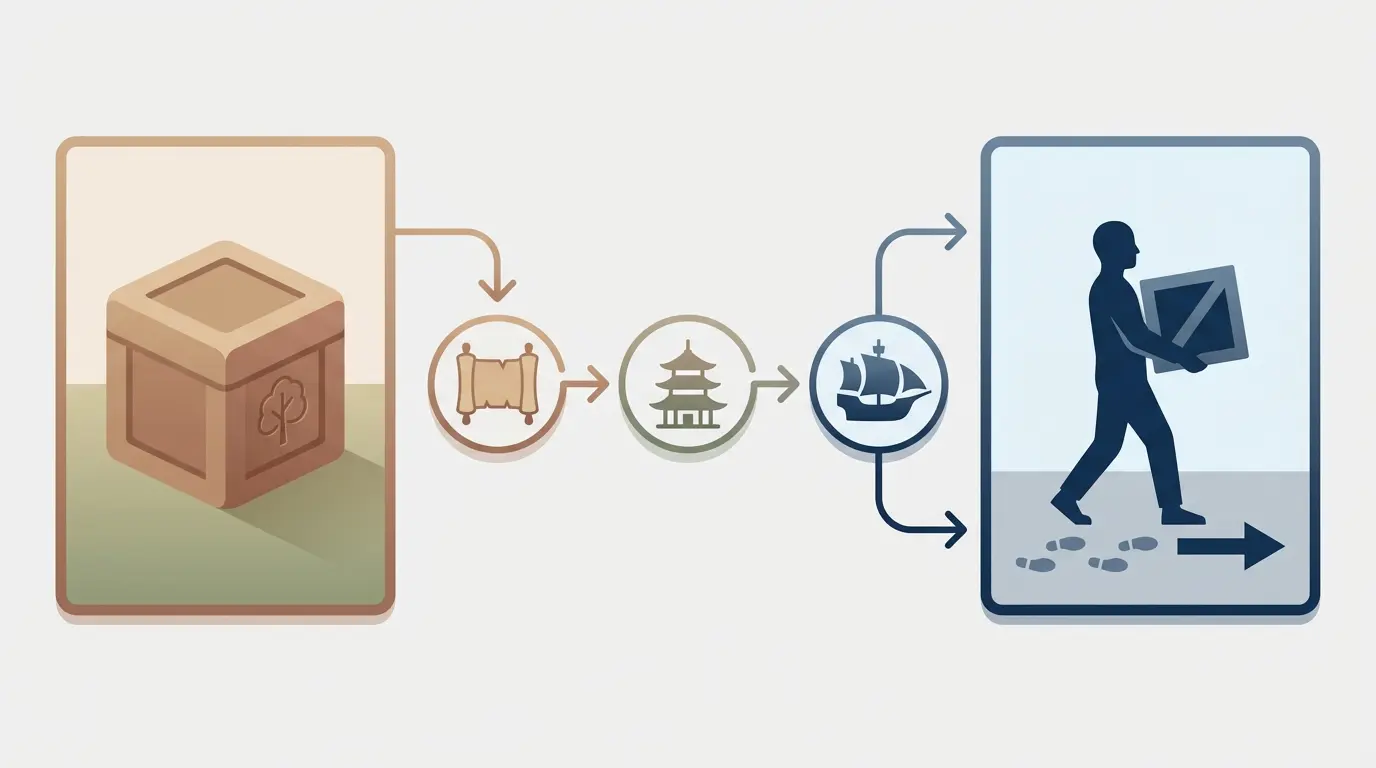
imageAltText: Illustration showing a stylized wooden box icon on the left panel, a person carrying a crate on the right panel, and a minimalist timeline with three icon nodes between them indicating Old Japanese, 9th century Buddhist citation, and 1603 Nippo Jisho transcription. Arrows show the phonetic flow from pako to hako and related verb forms.
Phonetic and suffixic considerations — Are 箱 (hako) and 運ぶ (hakobu) related? Etymology
This section examines the suffix ~ぶ and its relevance for the possible relationship between 箱 and 運ぶ. Scholars sometimes posit that ~ぶ is an older form of ~びる, which attaches to nouns to form verbs. However, several issues complicate straightforward derivation.
Key points and scholarly insights
- Suffixal hypothesis: Monolingual references argue that the suffix ~ぶ predates ~びる and could form verbs by attaching to noun stems. Therefore, a hypothetical noun pako plus suffix -bu could yield pako-bu, plausibly producing a verb meaning to box or carry.
- Transitivity problem: However, many treatments note that ~びる-derived verbs are often intransitive while 運ぶ is transitive. Therefore, if ~ぶ here is the same suffix as older intransitive-forming -びる, this complicates the account because the expected valency would not match.
- Wiktionary and historical notes: Wiktionary records meanings for related forms and notes semantic ranges such as “to cart; to carry; to bring about.” For an archived reference, see this link which preserves discussion of hakobu and suffix use.
- Corpus evidence: ONCOJ provides Old Japanese attestations for noun forms like hako and helps trace vowel types and phonetic classes. ONCOJ confirms Old Japanese data and vowel classification useful for assessing whether pako forms are phonetically plausible. Access ONCOJ at this link.
- Morphological alternatives: Some scholars prefer independent verb roots that coincidentally resemble the noun hako. In that case, semantic proximity arises from usage rather than common origin. Because direct evidence for Old Japanese hakobu (as pako₁bu or pako₂bu) is absent, this alternative retains plausibility.
In sum, suffixal and phonetic evidence remains suggestive but inconclusive. The suffix ~ぶ could explain verb formation, yet issues of transitivity and the lack of Old Japanese attestations for pako₁bu/pako₂bu prevent a definitive conclusion.
Comparison: Are 箱 (hako) and 運ぶ (hakobu) related? Etymology
| Feature | 箱 (hako) | 運ぶ (hakobu) |
|---|---|---|
| Kanji meaning | Box; container with lid; physical vessel. | To carry; to transport; verb of moving objects. |
| Earliest historical citations | NKD cites Nihon Shoki 720 and Man’yōshū c.759. | NKD cites a Buddhist text 883; Nippo Jisho records Faco in 1603. |
| Phonetic evolution | Reconstructed Old Japanese form pako; 乙類 o-vowel; p→h shift plausible. | No direct Old Japanese pako₁bu attestation; 1603 Facobi suggests later phonetic forms. |
| Linguistic notes | Noun well attested; vowel class aids reconstruction. | Suffix -ぶ possibly older -びる; transitivity complicates suffixal derivation. |
| Sources | Japan Knowledge, Kotobank, NINJAL | Kotobank, Meiji Gakuin University, Kyoto University Repository |
CONCLUSION
The question Are 箱 (hako) and 運ぶ (hakobu) related? Etymology draws a cautious answer. Hako shows secure Old Japanese attestations in the eighth century. However, hakobu first appears in the record in 883, leaving a chronological gap. Phonetic reconstructions propose pako as a precursor to hako. Moreover, transcriptions like Faco and Facobi in the 1603 Nippo Jisho show later phonetic stages. Suffixal analysis suggests ~ぶ may be older than ~びる. Yet transitivity in 運ぶ complicates a simple suffixal derivation. Because no direct text records pako₁bu or pako₂bu, the link remains hypothetical. Consequently, semantic similarity alone cannot confirm cognacy. Therefore, the best conclusion is tentative. These words may share a root, but current evidence does not prove it.
For readers who wish to dig deeper, tools like corpus searches, NKD entries, and ONCOJ data help. Nihoner.com also supports advanced study with integrated dictionary lookup, timeline visualizations, and interactive kanji breakdowns. In short, further philological work and corpus discovery could change this picture.
Frequently Asked Questions (FAQs)
What is the short answer to Are 箱 (hako) and 運ぶ (hakobu) related? Etymology
The short answer is tentative. Hako appears in Old Japanese texts by 720 and 759. Hakobu is first cited in 883. Therefore a link remains possible but not proven.
Could 運ぶ derive from 箱 plus a suffix like ~ぶ
Possibly, because scholars treat ~ぶ as an older form related to ~びる. However transitivity in 運ぶ complicates this view. As a result the suffixal derivation is suggestive yet inconclusive.
What do forms like pako, Faco and Facobi tell us
Reconstructed pako explains how hako may have evolved phonologically. Nippo Jisho transcriptions Faco and Facobi show later pronunciations recorded by Europeans. Thus they map phonetic stages but do not prove derivation.
Where should I check primary evidence
Consult Nihon Kokugo Daijiten entries, ONCOJ corpora, and historical dictionaries like Nippo Jisho. Also check lexical notes on Wiktionary for comparative senses. These resources verify attestations and vowel classes.
How should learners remember usage and nuance
Remember that 箱 is a concrete noun, and 運ぶ is an action verb. Therefore think container versus movement. For etymology study, focus on sound change, suffix behaviour, and primary corpus citations.